TL;DR
- The template is a thinking framework, not a writing shortcut. Its real value is structuring research, intent, and positioning before content is written, so humans can produce better output with AI support.
- Topical clarity beats volume in modern SEO. A well-mapped page bracket aligned to keywords, pain points, and SERP reality is more effective than publishing more content faster.
- Improve the quality of your content research + output. Combining SEO tools, real SERP analysis, and NotebookLM sources dramatically improves outline quality and reduces generic, low-value content.
As a follow-up to my old SEO content template that I have been using for years, I wanted to develop a more in-depth one that incorporates LLMs + research. This all came from Britney Muller’s Actionable AI Course I took last year. Can’t recommend this course enough, and she has revamped it to be even more in-depth. If you read this, you are curious about AI/LLM marketing. Sign up for this course!
This template incorporates using a few different SEO tools + Notebook LM. I’ll show my example I used to write this post and link a blank version that can be copied and updated for your needs.
This template should get you started, but it will not do 100%. I have been using this a lot and have made tons of tweaks. The way to get the most out of it is to use this process to create the template, not write the full content. A human will use this template and create the content based on the LLM output.
Why You Need an SEO Content Template in the Era of AI
With the rise in AI & LLMs, content is coming out faster than ever. Most of it is probably junk, but with that, people are learning how to spot junk. The goal of SEO used to be to publish content; content is king they say. It really shouldn’t have been, but it worked for many.
As teams scale their use of AI tools, it’s equally important to think beyond output quality and consider the risks tied to handling data. Many workflows involve sensitive inputs, and without proper safeguards, this can introduce compliance and security concerns. Implementing clear processes around data privacy when implementing AI solutions ensures that efficiency doesn’t come at the cost of trust or long-term risk.
Now you need to focus way more on humans. Understand their problem and how your business fits in as the solution. Whether you are offering a service or product, you are solving something for your customers. The LLMs are diving deep into understanding this and are promoting the quick answers/solutions.
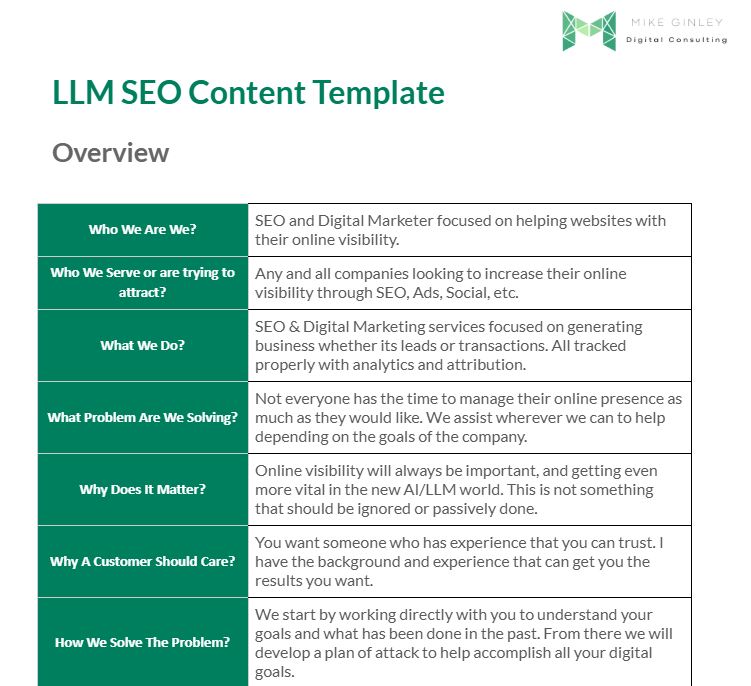
Key Components of My AI SEO Content Template
Overview
- Who We Are We? – Briefly define the brand and core expertise in a clear, credibility-building statement.
- Who We Serve or are trying to attract? – Identify the ideal audience so the content speaks directly to the right reader.
- What We Do? – Summarize the services or solutions offered in plain, outcome-focused language.
- What Problem Are We Solving? – Clearly state the primary pain point the audience is experiencing.
- Why Does It Matter? – Explain why this problem is important and what happens if it’s ignored.
- Why A Customer Should Care? – Connect the problem to the reader’s goals, risks, or desired outcomes.
- How We Solve The Problem? – Outline the high-level approach or methodology used to address the issue.
- How To Get Said Solution? – Provide the next step for engaging or working with you.
- What is our background, why should people trust us over anyone else? – Highlight experience, results, or proof points that establish authority and trust.
- How can we connect to them? Are we local, have we been around a long time? Show relatability through locality, longevity, community involvement, or shared values.
- Brand + Pain Point – Tie the brand directly to the core problem it is uniquely positioned to solve.
- Is This For Me – Clarify common questions about who you typically work with. Calm any concerns if someone may think you aren’t the business/service/product for them.
- Emotion – Acknowledge any feelings people may have. Depending on your offering, there are likely some emotions that are involved. Bring in the human touch.
- Proof – Encourage the inclusion of proof points that set your product/service apart from the competition.
- Bais – Are there any biases that people may have about your product or service? Acknowledge them and calm the concerns if possible. Shoutout Garrett Sussman!
- What do we want people to do after digesting this content? – Define the primary call to action for the content.
- What Happens Next – After someone engages, what happens? Is there a process that happens that they should know about?
- What are the top 3-5 links for the primary keyword? – Reference authoritative or competing pages currently ranking for the topic.
- Anything to call out about the SERP? – Note SERP features, intent patterns, or competitive gaps to address.
- Stats/Metrics to help support? – Include data points that validate the problem, solution, or opportunity.
Keywords/Topics
- Primary – The main keyword the content is built around and optimized to rank for.
- Secondary – Supporting keywords that reinforce the primary topic and capture related intent.
- Related – Closely associated terms and concepts that help expand topical relevance and coverage.
- Fanout – Broader adjacent topics used to extend reach, internal linking, and future content opportunities.
Bonus tip, pair this with the automated Low Hanging SEO Fruit process.
Page Information
- URL – Define the clean, keyword-focused page path used for the final published content.
- Title – Write the SEO title tag that clearly communicates topic relevance and entices clicks.
- Description – Create a concise meta description that summarizes value and encourages engagement from the SERP.
- Links To Include – List internal and external links that add context, authority, and user value.
Page Bracket
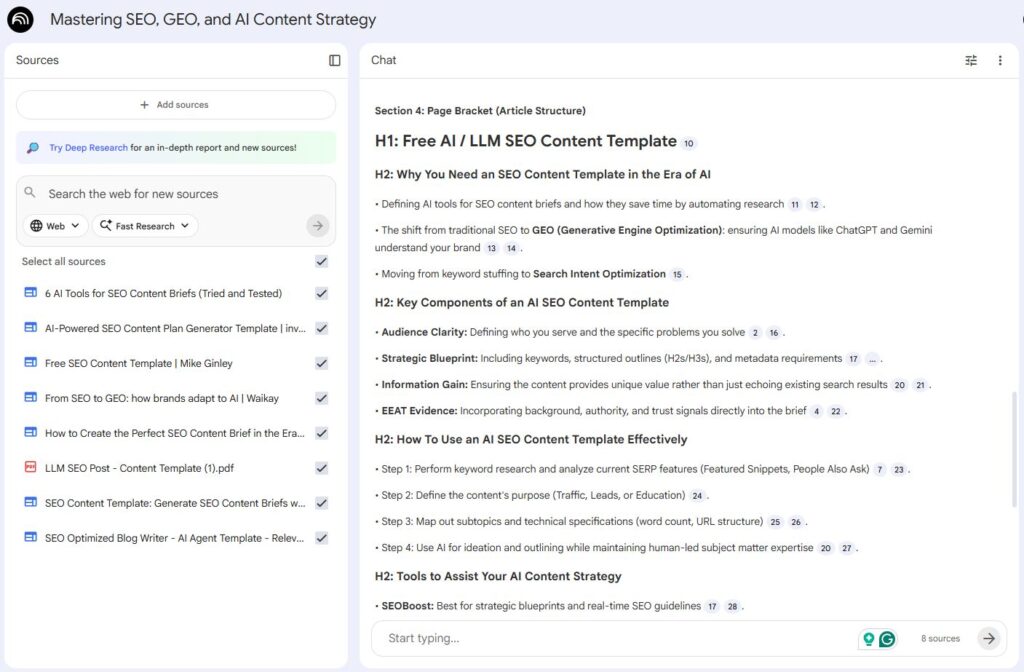
- H1 – Uses the primary keyword and defines the core topic of the page.
- H2 – Targets secondary keywords while expanding on key subtopics of the primary theme.
- H2 – Covers related keywords to deepen topical authority and address adjacent user intent.
- H2 – Introduces fanout topics that support internal linking and future content expansion.
How To Use My AI SEO Content Template Effectively
- Step 1: Make a copy of the blank AI SEO Content Template.
- Step 2: Fill out the Overview Section. This is important; it will feed NotebookLM with the info needed to build the page bracket.
- Step 3: Map out the Keywords/Topics. Use Ahrefs, search the priority keyword and pull Fanout topics.
- Step 4: Fill out the Page Information to incorporate key meta information.
- Step 5: Optional – Fill out the headlines you want in the page bracket; you can force the LLM to use a certain structure.
- Step 6: Download the bracket as a PDF.
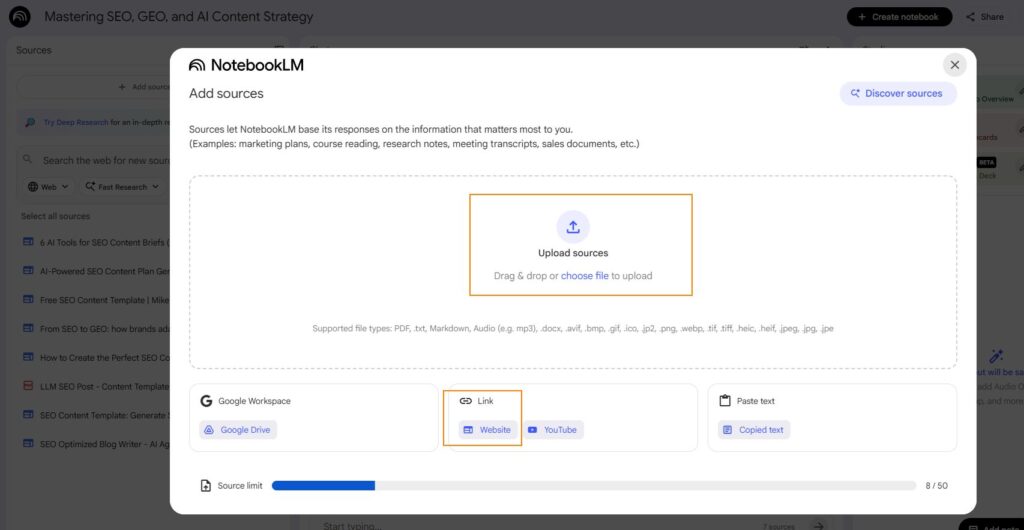
- Step 7: Upload the PDF into NotebookLM Sources, and paste the Sources you found earlier in the Links section.
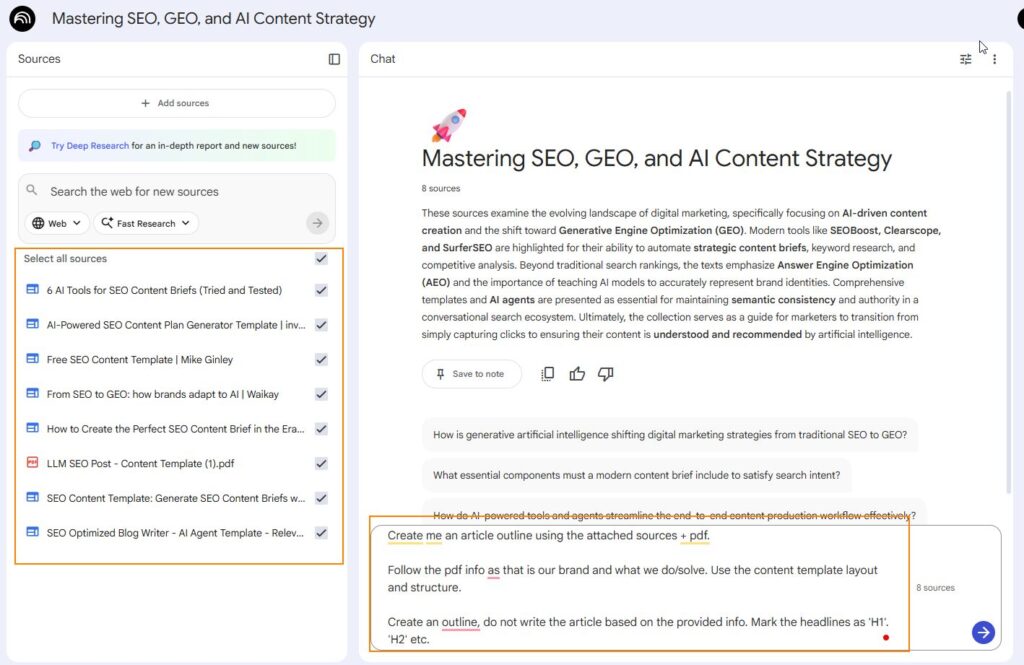
- Step 8: Use the prompt below to create the Page Bracket.
- Step 9: Paste into your content template and send off to your content writer.
Page Bracket Prompt
Create me an article outline using the attached sources + pdf.
Follow the pdf info as that is our brand and what we do/solve. Use the content template layout and structure.
Create an outline, do not write the article based on the provied info. Mark the headlines as ‘H1’. ‘H2’ etc.
Tools to Assist Your AI Content Strategy
Ahrefs: Used to research keywords, analyze competitors, and understand backlink and ranking opportunities.
Google AI Overviews or ChatGPT: Used to assess how AI models interpret the topic, summarize intent, and surface brand or concept coverage.
NotebookLM: Used to analyze, summarize, and extract insights from source documents to support accurate, grounded content creation.
Waikay: New tool I’ve been looking into, essential for measuring visibility within generative engines (GEO). What AI Knows About You (Waikay).
SerpRecon: Another new tool I’m looking into. Used to analyze SERP features, volatility, and competitive movement for priority keywords. Brings in some pretty intense metrics known to be used in search engine algorithms (BM25, Cosine Similarity).
AI SEO Prompts and Best Practices for Implementation
Garbage in, garbage out.
Remember that when crafting prompts. The more broad it is, the more broad the output.
- 15 Best LLM AI SEO Prompts for Marketing Automation
- 28 AI Prompt Ideas & Example Templates For SEO
- 50+ AI Prompts for SEO – PromptDrive.ai
How Mike Ginley Digital Consulting Can Help
Effective digital marketing isn’t about chasing trends or adding unnecessary complexity, it’s about doing the right things consistently to generate real business results.
With over a decade of hands-on experience, a straightforward approach, and a focus on building close client relationships, the goal is simple: create strategies that drive measurable leads and transactions. If you’re ready to improve your online visibility with a partner who prioritizes outcomes over noise, reach out through my website or social channels to get started today.